Bill White's roleplaying game design blog, with emphasis on narrativist or story-heavy games.

Showing posts with label Rune Saga. Show all posts

Tuesday, June 02, 2009

Whither Rune Saga? Post-Nerdly Prospects

I didn't run any Rune Saga at Camp Nerdly 3 this weekend (the run-down on what I did run ishere), but the game wasn't far from my mind, as I considered Bruce's comments in a previous thread: should I use the game to experiment with "jeepforged" structured freeform-type techniques, or develop it as a tabletop story-game. I had thought the former, but Bruce's comments gave me pause.

Bruce says:
Freeform/jeepforge is somewhat outside my comfort zone but I'm very interested in your efforts to develop "techniques to facilitate player engagement with their characters without sacrificing the narrative coherence that oracular mechanics provide." 
. . . To my mind, the tarot-based oracular game mechanics make Rune Saga unique so I wouldn't worry that In A Wicked Age occupies the same "space." I think the two games are very different despite the fact that they are both "sword-and-sorcery story games."
Whichever direction I take the game, I'd like to avoid the pitfalls of "parlor narration" -- a term of opprobrium that suggests that the game is a purely mechanical exercise with some fictional elements "tacked on" in an inessential sort of way. In other words, I want there to be a space for role-playing within the game, for engaging with the fiction to be essential to the game's forward movement: You get to the end, you've told a story, and you've felt it.

So in my last few designs, I've toyed with the idea of using emotion or attitude game-mechanically: in order to achieve this task or participate in this encounter, you have to act a particular way. Take a look at The Great City and The Perilous Realm and you'll see what I mean. My notion is that these things may give the player the freedom to act in character, rather than in purely "rational" utility-maximizing ways.

Bruce goes on:
For me a major appeal of your designs is the support they provide to situation generation during play. Generally RPGs rely on the DM and players to decide what situations the PCs are presented with. Mechanics are provided to determine success or failure and to arbitrate conflicts; guidelines may even be provided such as "threaten PC beliefs" etc; however it's largely down to the DM (or other participants) to come up with interesting situations which advance the fiction.
In your designs the participants aren't asked to determine "what happens next?" they're asked to interpret the cards. This is easier somehow and works surprisingly well considering there's no 'architect' guiding the story. There's a degree of 'magic' being employed here I think.
Yes! Magic, indeed. It's the same sort of magic that lets charlatans and mountebanks fool the unwary, but we use it for good. People's minds naturally want to impute meaning to patterns: random noise plus human perception equals deep significance, as someone once told me.

And that's why I think that when we're playing Ganakagok a card will come up as the situation or the consequence and people will laugh, because the appropriateness of the card in the context of what has gone before seems uncanny. It isn't, of course; it's just our minds filling in the blanks for us. This is to some extent a learned skill. These days, when I run the game for new players, I often find myself saying, "Now, there's an obvious interpretation of this card. . ." But it's not obvious at all; it's something I've learned how to do.
Anyway, I'm curious, did you consciously aim to target this in your designs or has the added 'support to situation generation' arisen out of other things?
I had been playing around with oracular systems prior to writing Ganakagok, but they were a solution without a problem for me until then. Then after the first run of the game in January 2005, sans cards, part of the feedback I got was that it was hard to figure out what to do. I had been relying on a kind of resource management thing to drive the action: you have such-and-such amounts of bone, oil, meat, and hide, so maybe you'd best go hunting. But it wasn't easy to tell what the numbers were saying you should do, and hard to keep track of in any case, so it was easiest to jettison those rules and replace them with a Rune Saga-like deck of cards that would serve as a qualitative  and descriptive system for coming up with statements about the world like "The people are starving." Best go hunting, then.

Since then, I've never looked back. Jason Morningstar has accused me of being a "slave" to my "house style," but I prefer to think of myself as inimitable.
Your Fourth Age D&D rules would appear to address this specifically for D&D. In your words turning it into more of a "pick-up game."
Exactly so. I'll be running a D&D mini-campaign this summer if all goes well; I'm regarding it as an experiment in "ganakagok-ified" gaming.
Thirdly, I wonder if you might divulge any elements of the process you went through to establish the card meanings in Rune Saga and Ganakagok? Do I detect some of Vladimir Propp's narrative functions? I'm intrigued and fascinated. The symbolism which you've assigned is not only very effective but resonates quite strongly with me personally.
The Rune Saga cards came first, and were created by re-skinning the I Ching's trigrams with some of the key major arcana from the Tarot (Child is really the Fool, Man is really the Magician, and so forth). The suits are thinly veiled Tarot suits assigned elemental meanings and used to create specific identities for each card. The events associated with each card are pure Propp. The interactions of card values (the "glyphs") are simplified versions of the I Ching hexagrams. 

It was a lot of work! Pleasant, puzzle-solving work, but work nonetheless.

Having done it once, though, it was easy to do it again for the Ganakagok deck. This time I simply re-skinned the meanings of the minor arcana of the Tarot with quasi-Inuit flavor, melding the Knight and the Page into the Child of any given suit when necessary. I think I extracted a Nitu numerology from the card meanings, but that came after the basic meanings were already fixed.

A few things helped me in the process: Robert Graves's The White Goddess, with its notion that poetry is the preservation of (druidic) knowledge of the world expressed in riddle and metaphor, and Algirdas Greimas's Structural Semantics, which is all about unpacking the latent semiotics of any given system of meanings.

So the thing to do, I think, is go back through these old designs and see which ideas are most compelling, interesting, or novel, and pull them in to a revised Rune Saga. In the meantime, I'll play around with Ganakagok Jeepforged to see what can be pulled from that game. Ultimately, I think I'd like the game to feel like The White Goddess: a powerful mythic connection to a time long-past-if-ever.

Monday, May 25, 2009

Rune Saga as Structured Freeform

"Rune Saga" was the game I was working on when I discovered The Forge, and I drew from it in order to create the tarot-like Ganakagok deck. In the comments to a previous post, Bruce mentioned that he'd like to see some further work on the game, and I'm inclined to agree. A lot of work went into creating the Rune Saga deck -- I'll call it semiotic heavy lifting, if you know what I mean.

In the interim, however, Vincent Baker wrote In A Wicked Age, which occupies the space that Rune Saga was aimed at: oracular indie-tabletop sword-and-sorcery story-game. It seems to me that the world doesn't need two such games. Why write an IAWA heartbreaker?

The one thing that I've been trying to do in my post-Ganakagok designs is make space for role-playing. In other words, narration-intensive play, as in Ganakagok, is just that: heavy on players narrating what happens rather than role-playing their characters. The effect is, I think, somewhat distancing. In other words, I'm looking for techniques to facilitate player engagement with their characters without sacrificing the narrative coherence that oracular mechanics provide.

This is where the emerging design philosophy of structured freeform offers a potential solution. My first experiment with this method was the "jeepforged" version of Ganakagok, which I playtested at Knutepunkt in April 2009 and will run again at Camp Nerdly at the end of May.

A jeepforged Rune Saga would use the 32-card deck not as the territory upon which narrative control could be contested; rather, the cards are played as prompts for role-playing as well as beats in a narrative.
BEGIN THE GAME by dealing out two cards from the Rune Saga deck. The entire group discusses potential meanings of the individual cards and their combination and consensually decides the initial situation that it signifies.
DETERMINE WHO GOES FIRST by dealing each player a single card. The player with the "lowest" card goes first (with card values rankedael, bes, cad, din, eth, fel, ghot, and hin and card suits ranked swords, coins, staves, stars). The player with the "highest" card becomes the Demiurgical Mediator (DM) for the episode.
Don't worry; we'll figure out a way to make each game relatively short, so the DM role shouldn't be terribly onerous. Additionally, the suit of the card the player receives might suggest a goal for the player: death confronted for Swords, love requited for Coins, innocence lost for Staves, evil averted for Stars.
THE DM DEALS THREE CARDS TO EACH PLAYER after shuffling the cards back into the deck. 
PLAY THEN PROCEEDS with each player on his or her turn becoming the Player in Charge (PC). The other players are Not the Player in Charge (NPCs). The DM doesn't take a turn; instead, he or she is allowed to react in specific ways to the actions of the PC.
  • Play a card to introduce a new character. Take an index card and give the character a name as well as a type: innocent, hero, elder, or villain. Record the card that created the character, and the character's active and reactive qualities based on the suit of that card (see below). Deliver a monologue as the character to introduce him or her and give his or her perspective on what's going on in the fiction of the game. The DM may at his or her option take the role of a supporting or minor character (a servant or attendant; a soldier, guard, or functionary, e.g.) to introduce the glyph formed by combining the last card played and the new card as the new character's immediate prospects.
  • Play a card to introduce a new in-game feature, such as a location, artifact, obstacle, and so forth. Take an index card and record the name of the feature as well as the card that created it. Provide a description of the feature via some in-game persona; e.g., a sage, scholar, or other knowledgeable person; a victim or eyewitness; a local; etc. At his or her option, the GM may take the role of some interlocutor (a querulous rival, a skeptical student, a curious traveler or bystander) to interrogate the PC and introduce the glyph associated with the last card played and the new card as the feature's immediate prospects.
  • Play a card to start a scene. Frame a scene in line with the event on the card. Give NPCs characters to play or features to represent in the scene (neither the PC nor the DM play characters in the scene). Typically, a "scene" consists of an encounter between two characters, or between a character and some in-game feature.
  • Discard a card and draw a new one. This amounts to passing  your turn.
DURING A SCENE, the NPCs take the roles of the characters they've been assigned. They try to behave according to their qualities, as determined by the cards used to introduce them.
  • Swords. The character acts by demonstrating cleverness. The character reacts by showing grief, sorrow, or fear.
  • Coins. The character acts by demonstrating bravery. The character reacts by showing happiness, elation, or joy.
  • Staves. The character acts by demonstrating wisdom. The character reacts by showing anger, rage, or jealousy.
  • Stars. The character acts by demonstrating virtue. The character reacts by showing calm, serenity, or patience.
Once a character has acted and another has reacted, the GM may intervene by reading the glyph formed by the combination of the acting and reacting characters' governing runes (i.e., cards). The GM may do this by directing one or both of the characters to act in a way consonant with the glyph, or by instructing another NPC to enter the scene either as a main or supporting character with a role or purpose appropriate to the glyph. The GM may do this "on the fly" by whispering into one or more character's ears, or tell the players to freeze and giving more general stage directions.
The PC may intervene in a scene at any time by interrupting the action to give one of his or her cards to an NPC who is already in the scene; this changes the suit of the card that "governs" the character the NPC is playing. However, the GM is allowed to intervene by reading the glyph formed by the combination of old and new card, and directing the character's fortune appropriately.
Any NPC who is not in the scene already may discard one of his or her cards to pick up a previously defined character who is not in the scene and make an entrance with that character.
THE EPISODE ENDS when no one wants to play any more cards. Discard any cards that you may still hold. If there is time and inclination, shuffle the deck and play a new episode.

Friday, May 22, 2009

Revisiting Rune Saga

Over the next few weeks, I'm going to be revisiting Rune Saga, my unfinished game whose oracular cards were in my opinion ahead of their time. My goal is to be ready to playtest at Dexcon. Held in July, this gaming convention is a particularly friendly venue for playtesting.

To get things started, I've created a functional Rune Saga deck, available here as four separate PDF pages plus a separate card back page. To use, print out each page on cardstock, flip them over in the printer paper tray, and print the card backs.

That way, you can play at home as design and development move forward. Background information on the constitution of the deck is available in older posts, so if anything seems mysterious, check back there.

Friday, January 20, 2006

Rune Saga: Narration Constraints

It's probably worth it to think about how to establish bounds on what can be done by the narrator (that is, the person with narrative control at a given time). The issues that matter I think include the following:

(1) Is the narrator acting as PC or as DM? That is, is he thinking advancing the dramatic interests of a particular character or about providing adversity to that character?

(2) Is a particular character involved in the narration the creation of the narrator or of somebody else (and was that person involved in the contest for narration rights or not)?

(3) How does the narration implicate the character's, um, character? That is, to what extent is the narration something happening to the character or something chosen by the character? Call the former "external locus of control" and the latter "internal locus of control." Internal locus narration creates the character's persona, and this is [unexamined assumption] something that probably belongs to the character's "owner" (that is, creator) [/unexamined assumption].

(4) To what extent does the narration extend or contradict what has been specified in previous turns? Or, better, how consequential is the narration?

So in the post from Jan 19, Joe's initial narration invokes Andaman, Melina, and the Heartshard. He's bringing them into the scene in order to frame up some possible tough choices for Daemien. Joe leaves the specific threat unspecified; Andaman may be going to kill or hurt Melina, or maybe he's a romantic rival. But it's clear that Joe is acting as the DM. Andaman and Melina are characters he created, and so he has "ownership" of them. The Heartshard is something I created, and so I guess I have ownership of it. Should I be able to veto Joe's assertion that the Heartshard has the power to lead its possessor to that which is alien to the Wild Wood? I want to argue that the DM-function trumps ownership in this case--especially because there is a runic motif that Joe is invoking to justify the inclusion of that element in his narration (i.e., ghot luemas, a thing of blood). The narration ascribes intentionality to Andaman (he is tracking something) and emotions to Melina (she's lost and afraid), which is something that's okay to do with a character you created.


So now when Andaman comes face-to-face with Daemien, who gets to say what happens, and what are they allowed to say happens? Winning the die roll is important, as is DM/PC role assignments, as are character creator rights, as is adherence to the meaning of the runes and glyphs involved in the narration.

DM wins roll for own character -- very strong narration rights.
DM wins roll for other character -- strong narration rights.
DM loses roll for own character -- strong veto.
DM loses roll for other character -- moderate veto.
PC
wins roll for own character -- strong narration rights.
PC wins roll for other character -- weak narration rights.
PC loses roll for own character -- strong veto (internal locus)
PC loses roll for other character -- weak veto


This still needs work.

Thursday, January 19, 2006

Rune Saga: The Heart of the Wild Wood

Let's stipulate that if you continue a story after some interval (as in a "campaign," e.g.), you throw in your hand and deal out new cards when you get back together to play. So imagine Joe and I are going to continue the story of the Wild Wood after having to deal with the real world for a while. We each get three cards.
My hand: Lady of Stars, Tree of Coins, Mount of Staves.
Joe's hand: Man of Stars, Tree of Staves, Child of Stars.
On my turn, Joe is DM. He flips the top card of the deck; it's Sun of Stars (ghot luemas), which can be read as an artifact of blood.
The whisperings of the Heartshard lead Andaman to his quarry; the ancient heart of the forest can sense that which is alien to it. He comes upon Melina, lost alone and afraid, in the dark of night.

I see what he's doing; does Daemien come to Melina's rescue? Does she even need rescuing? Hrmm. I want to use my Stars, since it produces the best glyph (Increase) but I probably won't get control. But I'll play Lady of Stars to establish as a character the she-wolf that befriended Daemien.
There is a growling in the darkness as Andaman nears the firelight of Melina's rude campsite, and he pauses in shadows. Glittering green eyes stare out from the trees. A great grey she-wolf, larger than a mastiff, pads forward with tongue lolling out of her grinning jaws. Around her neck is a silver chain that Melina recognizes as one that she'd given her prince Daemien.

I roll a 3; Joe gets control. But the glyph is pretty positive for me: ghot bes (Increase) He gains advantage by his action, and his fortunes increase.
"Who are you?" says Melina to the she-wolf. "Do you know my Daemien? Will you take me to him?" The wolf makes a noise like a sneeze, and Melina laughs. She follows her away from the firelight and deeper into the woods. "Isn't this lucky?" she says to the wolf, though she expects no response. "Both of us who love him are coming to him." Andaman smiles mirthlessly as he follows.

Now it's Joe's turn; I'm the DM. I think it should be a rule that if you start your turn "on the scene" as it were, you can play a card to immediately continue the action, reading the glyph that intervenes as well as the rune you play. So Joe plays Tree of Staves to create the glyph "Ambition" (Andaman's). His Virtue is 3 and he rolls a 2, so gets to read it; he describes Andaman's desire to fulfill his oath to Melina's father. I make him say that he hurries after the wolf and the girl; he isn't careful, and he doesn't pay attention to the quiet rustlings around him. This is to include the meaning of overreaching that ambition contains. Andaman bursts into the cave where Melina is kneeling beside Daemien; he recognizes the prince.
Now there are two primary characters in the same scene. Do we need special rules? Or are the special powers afforded the DM enough?
Have to think about this.

Rune Saga: Joe's Turn

There are only two players, me and Joe. I've just taken my turn. Now I'm the Demiurgical Mediator (DM--get it?) and he's the PC (principal character).

Joe needs to create a character. He draws Man of Coins, Tree of Stars, and World of Swords.
  • Man of Coins cadhtaenas King (Escape). One who is contented. Event: Someone evades pursuit.
  • Tree of Stars dinluemas Thought (Counteraction). A church, sect, or cult; a faction committed to a particular means or end. Event: A hero learns of a means to redress an act of villainy.
  • cadh din Arrival The one who acts comes to a stopping-place. This place may not be the end, but a leg of his journey is complete.
  • World of Swords hinsothas War (Death). An evil place; a time of grief. Event: Something long awaited comes to pass; old things pass away; an era closes.
  • din hin Strength The one who acts, by virtue of his strength, achieves a great success.
His character is Bravery 3, Cleverness 3, Virtue 3, Wisdom 2. Joe decides that he wants to play one of the hunters sent out by Melina's father. He names the character Andaman the Bold.
Andaman the Bold leads the chase through the Wild Wood, but Daemien evades the hunters [Man of Coins (Escape)] when the wolf-spirits of the forest harry them through winding and tangled thickets and underbrush [Tree of Stars (Totem-Spirit Maze)]. Winning free of the green labyrinth, Andaman and his companions face the Dark Heart of the Wild Wood [cadh din (Arrival)], an ancient and evil tree spirit that descends upon them in a frenzy of thorns that tear at their flesh and vines that bind their limbs. The other hunters are killed in the fight against the creature [World of Swords (grief)], but Andaman finds the resinous pulsing red crystal at the core of the Dark Heart and crushes it by main strength [Strength (great success)].
Joe discards his cards and draws three new ones (Mount of Coins, Child of Swords, and Tree of Swords). I draw a card to serve as his initial situation, and it's Mount of Coins (ethtaenas Treasure (Receipt of Gift). A secret. Event: A hero receives a helpful gift). I decide that the card represents the Heartshard, a splinter of the Dark Heart of the Wild Wood.
The Heartshard pulses with an evil crimson glow; it is an irregularly shaped globule about the size of a man's fist. A whispering, half-heard voice seems to come from nearby, speaking urgently but just below the threshold of perception.
Joe needs to decide what to do. Playing Sun of Stars gets him Sanctuary, but only a 33% of winning narrative control. Playing either of the Swords gets him a 50% of winning control, with Child of Swords becoming Adversity and Tree of Swords becoming Respite. He decides that the notion of a struggle between Andaman and the Heartshard makes the most sense, so plays Tree of Swords.
The obscene jewel colors Andaman's vision like blood, and the evil whispers become clearer, full of putrid corruption--atavistic desire--seething rage. Andaman claps his hands to his ears to shut out the insane mutterings. "Get out of my head!" he screams.
He rolls a 2 and so wins narrative control. He says,
The effort of will brings him respite, and he wraps the Heartshard in bloody cloth cut from one of his dead companion's cloak.
And there the turn ends; we draw cards to bring our hands back up to three and shuffle our discards into the deck.

Wednesday, January 18, 2006

Rune Saga: What a Turn Might Look Like

It's my turn; I'm playing Prince Daemien. Another player (the person whose turn is next, let's say, or better--the person directly across the table from me, or the [N/2]th player from me, rounded down) draws a card from the rune deck and reads it as something relevant to my character.

Let's say Joe draws besothas, the Lady of Swords.
Lady of Swords [besothas] Maiden (Departure). One who is in danger; one who experiences grief or misfortune. Event: A hero leaves his home or proper place.
Joe likes the notion of a grieving maiden; he imagines the girl Daemien has left behind. He introduces her as a character, an innocent hurt by Daemien's abandonment.
Damosel Melina, the daughter of rich noble family, had accepted her betrothal to Prince Daemien at a midsummer festival before his departure for the wilderness. Their courtship over the next few weeks had made her happy beyond her dreams, and his disappearance has weighed upon her. She has decided to leave home and search for him, despite the wishes of her father that she accept a new suitor.
I have a hand of cards:
  • Mount of Stars ethluemas Guidance (Violation). An expanse of water. Event: A hero violates an elder's interdiction (perhaps unknowingly).
  • Child of Staves aelmaegas Seeker (Reconnaissance). One who desires knowledge. Event: A villain deploys minions against a hero.
  • Sun of Staves ghotmaegas Discovery (Remediation). A scroll, book, or map. Event: A hero finds something that is needed or has been missing.
I need to play one of them as a "response" (even if only indirect) to Joe. I'm interested in Damosel Melina, and think it'll be interesting to follow her on her quest to find Daemien. I decide to play the Child of Staves:
Damosel Melina leaves her home and journeys to the wood where Daemien was last seen. Her father sends his best huntsmen to find her and bring her home.
Now there's a moment of resolution. The glyph in question is produced by the two cards that have just been played: Joe's situation card and my response. The glyph is besael.
bes ael Folly The one who acts is led astray by his choice. He makes himself vulnerable to the stratagems of his enemies.
Who gets to decide what this means? Either me or Joe, based on the roll of a die. Since my response was a Staves card, we use Daemien's Wisdom as the target. If I roll 4 or less on a six-sided die, I get to narrate what besael means here. If I roll a 5 or a 6, Joe does. Let's pretend I roll a 5. Aargh!

Joe says, "The folly is not Melina's--it's Daemien's! All this is about his choice to go haring off into the woods instead of trying to get home. As Melina flees from her pursuers, searching for her lost love, she is spied by Daemien, who is skulking around there. He lets her pass by -- a big mistake! -- and is spotted by the huntsmen, who start chasing him through the woods."

And that's the turn. The next player gets a situation card, and play proceeds from there.

Rune Saga: Attributes

There are four attributes whose function in play is to influence narrative control.
  • The attribute associated with Swords is Bravery.
  • The attribute associated with Coins is Cleverness.
  • The attribute associated with Stars is Virtue (or Piety).
  • The attribute associated with Staves is Wisdom.
The value of an attribute for a character is equal to 2 plus the number of runes of that suit in the character's pentad. So Prince Daemien (with two Staves and a Coin) has Bravery 2, Cleverness 3, Virtue 2, and Wisdom 4.

I'm still reading and reading about Greimas, so let's see if we can map the four attributes into the semiotic square.

Remember that a semiotic square is constructed like this:

S: semantic category

s <---> non s
X
~(s|non s) <---> s & non s

~S: semantic anti-category

that is, a positive term contrasts with a negative term (the top row), each of which has a corresponding complement below it, consisting of contradictions of both the positive term (both positive term & negative term)and negative term (neither positive term nor negative term).

S: 'Honor' ['Valor']

bravery <---> cowardice
X
foolhardiness <---> prudence

~S: 'Survival' ['Discretion']

Rune Saga: Creating Characters

To create a character, draw three cards from the rune deck (making sure to note the order in which they were drawn). Three cards produce a “pentad” consisting of three runes and two glyphs. The first glyph is produced by the first and second runes. The second glyph is produced by the second and third runes. These oracles are read in order, i.e., first rune, second rune, first glyph, third rune, second glyph. You “read” or interpret this “pentad” to create a coherent background.

Example: A player draws Sun of Staves, Moon of Coins, and World of Staves, which produces the following oracles.
  • Sun of Staves [ghotmaegas] Discovery (Remediation). A scroll, book, or map. Event: A hero finds something that is needed or has been missing.
  • Moon of Coins [feltaenas] Credulity (Unfounded Claims). A beneficent spirit, a guardian angel. Event: A villain pretends to be a hero, and receives acclaim.
  • ghot fel: Sacrifice. The one who acts gives up a precious thing.
  • World of Staves [hinmaegas] Nature (Transfiguration). A fiery or chaotic place. Event: Someone changes their aspect, or receives a new appearance.
  • fel hin: Abundance To him is given great wealth, as a lord his due.
The player uses this sequence of oracles to construct this background for his character:
PRINCE DAEMIEN is the son of a mighty king. He was given the task of charting the land on the frontiers of his father's kingdom [Sun of Staves (Map)]. He set out with local guides through a wild wood, but out of spite they tricked him into taking a cursed path where he wandered for a long time, hungry and alone [Moon of Coins (Credulity)]. Befriended by a cunning she-wolf, he gave up his human ways to live like an animal [Sacrifice] and roamed freely through the forest [World of Staves (Nature)] as a prince among the wolves [Abundance].

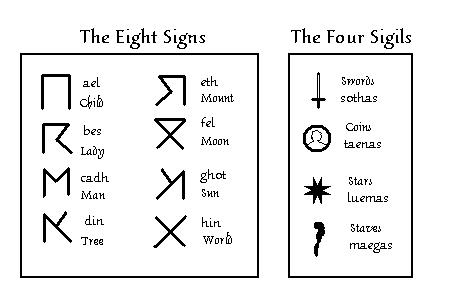
Rune Saga: Eight Signs and Four Sigils

Here is an image of the signs and sigils as I've imagined them. They could be used to create playing cards for a rune deck.

You can think of each sign as consisting of three lines each, some of which are straight and some bent. Ael, with three straight lines, represents zero and thus both nullity/absence as well as beginnings or initiations; hin, with three (overlapping) bent lines stands for the number seven as well as completion, fullness, or manifold existence. You can I think see the beginnings of a Oerish numerology here.

Tuesday, January 17, 2006

Rune Saga: The Glyphs

This is where things get a little opaque but hopefully oracular. There are 64 combinations of the 8 signs; these combinations are called glyphs. In the play of the game, the combination of an acting and reacting card or rune create a glyph that helps "resolve" what happens. In point of fact, one player is charged with interpreting the meaning of the glyph. Winning the right to interpret -- "narrative control," if you like -- is the game.

ael ael Ignorance The one who acts sets forth, as on a journey, but the way is dark. His knowledge is insufficient to the task he faces.
ael bes Initiative The one who acts strikes the first blow or makes the first move. His action brings some advantage.
ael cadh Seeking The one who acts searches, as for a treasure. There is little progress.
ael din Approaching The one who acts draws nearer to a goal, but the way is long. Still, the end he seeks is in sight, albeit from afar.
ael eth Refuge The one who acts finds refuge along a perilous way, as shelter from a storm. He is safe in repose.
ael fel Struggle The one who acts is beset; he engages with his foe directly. The advantage lies with the foe.
ael ghot Victory The one who acts advances, and the crown is his. There is great progress and success.
ael hin Strong Defense The one who acts attains a strong position of defense. He has shored up a weak point.

bes ael Folly The one who acts is led astray by his choice. He makes himself vulnerable to the stratagems of his enemies.
bes bes Temptation The one who acts is torn by a fateful choice. He may be led astray, as only a superior man is able to resist.
bes cadh Hidden Depths The one who acts possesses reserves of strength that may now be called upon, or may now be hidden away.
bes din Ambition The one who acts overreaches as his ambition drives him forward.
bes eth Retreat In adversity, the one who acts must withdraw.
bes fel Escape With proper action, he thwarts captors and pursuers.
bes ghot Good Advice The one who acts takes counsel, and gains advantage thereby.
bes hin Power The one who acts gains strength or influence by his action.

cadh ael Windfall The one who acts is granted good fortune serendipitiously.
cadh bes Overcoming By dint of his efforts, the one who acts overcomes an obstacle.
cadh cadh Peril The one who acts is surrounded by dangers. If he lacks virtue, he may be overcome.
cadh din Arrival The one who acts comes to a stopping-place. This place may not be the end, but a leg of his journey is complete.
cadh eth Stasis Action brings the one who acts no advantage; all remains as it was.
cadh fel Poverty The one who acts faces that against which his resources are inadequate. He is constrained, or has been refused.
cadh ghot Generosity The one who acts drinks his fill, as from a well. The willing gift of another is granted unto him.
cadh hin Perseverance The one who acts continues in his course. His efforts are not yet in vain, but neither do they bear much fruit.

din ael Labor The one who acts, by dint of his efforts, earns a small reward.
din bes Self-Reliance The one who acts merits a small advantage by his virtue.
din cadh Avarice The one who acts is bound by material things to his disadvantage.
din din Tree of Life The one who acts encounters a source of great gifts.
din eth Study The one who acts takes pains to remedy a lack of essential knowledge, which is is near.
din fel Progress The one who acts makes small advances in his efforts.
din ghot Keen Senses The one who acts discovers a weak point by his action.
din hin Strength The one who acts, by virtue of his strength, achieves a great success.

eth ael Adversity The one who acts is beset; his position becomes untenable.
eth bes Stalemate There is no advantage in action; all remains as it was.
eth cadh Heartache The one who acts faces a loss.
eth din Respite The one who acts pauses in his action.
eth eth Labyrinth The one who acts is ensnared as in a maze.
eth fel Empty Victory The one who acts finds any gain to be illusory.
eth ghot Sanctuary The one who acts arrives at a place of safety.
eth hin Hidden Perils The one who acts moves past an unseen enemy.

fel ael Restriction The one who acts is fettered; there is difficulty.
fel bes Nightmares The one who acts is beset by fears.
fel cadh Ruin The one who acts is stripped of fortune.
fel din Quick Thinking The one who acts achieves progress and success.
fel eth Rapid Advance The one who acts makes progress in his chosen course.
fel fel Guidance The one who acts finds guidance.
fel ghot Solitude The one who acts walks alone.
fel hin Abundance To him is given great wealth, as a lord his due.

ghot ael Contemplation The one who acts prepares; he is moved to some undertaking.
ghot bes Increase He gains advantage by his action, and his fortunes increase.
ghot cadh Celebration The one who acts celebrates good fortune and success.
ghot din Discontent The one who acts is discomfited; he has reason for dissatisfaction.
ghot eth Mourning The one who acts mourns his loss.
ghot fel Sacrifice The one who acts gives up a precious thing.
ghot ghot Doom The one who acts is subject to a malicious fate.
ghot hin Delirium The one who acts, lacking focus, is led astray, even unto madness.

hin ael Change The one who acts, indecisive, reverses his course.
hin bes Fulfillment The one who acts is satisfied with his acheivement.
hin cadh Abandon The one who acts is not steadfast, but pursues diversions.
hin din Friendship The one who acts is aided by allies; there is progress and success.
hin eth Calling The one who acts is called to love or duty.
hin fel Nurturing The one who acts engages in painstaking preparations.
hin ghot Prudence The one who acts acts prudently, and it is well.
hin hin The World The one who acts is granted a great boon.

Rune Saga: The Runes

The combination of sign (face value) and sigil (suit) produces the rune; there are a total of 32 runes, each with a number of alternate meanings. The table below is illustrative.

Swords


Child of Swords aelsothas Innocent (Masking). A child; an heir; a fool; one who is under constraint; one whose identity is hidden; one who acts naively or without forethought. Event: Someone takes on a new guise or semblance.

Lady of Swords besothas Maiden (Departure). One who is in danger; one who experiences grief or misfortune. Event: A hero leaves his home or proper place.

Man of Swords cadhsothas Warrior (Pursuit). A captain or leader of warriors; an athlete; a contentious person; one who comes to do harm. Event: A villain chases or hunts a hero, or vice versa.

Tree of Swords dinsothas Battle (Struggle). An army; a path strewn with obstacles. Event: Antagonists clash.

Mount of Swords ethsothas Fortress (Difficult Task). A wall, barrier, or mountain. Event: A hero faces or learns of an obstacle or challenge.

Moon of Swords felsothas Cowardice (Branding). An evil spirit or malicious spirit. Event: A hero receives a mark, brand, or scar.

Sun of Swords ghotsothas Valor (Victory). A weapon or instrument of harm. Event: A hero vanquishes a villain with whom he has clashed.

World of Swords hinsothas War (Death). An evil place; a time of grief. Event: Something long awaited comes to pass; old things pass away; an era closes.

Coins

Child of Coins aeltaenas Trickster (Trickery). A clever person; one who speaks glibly but without real knowledge. Event: A villain tries to deceive someone.

Lady of Coins bestaenas Queen (Complicity). One who is a joy to others; one who is beloved. Event: Someone is fooled or fails to exercise good judgment.

Man of Coins cadhtaenas King (Escape). One who is contented. Event: Someone evades pursuit.

Tree of Coins dintaenas Trade (Arrival). A family. Event: A hero arrives at a new place.

Mount of Coins ethtaenas Treasure (Receipt of Gift). A secret. Event: A hero receives a helpful gift.

Moon of Coins feltaenas Credulity (Unfounded Claims). A beneficent spirit, a guardian angel. Event: A villain pretends to be a hero, and receives acclaim.

Sun of Coins ghotaenas Justice (Exposure). A crown or royal jewel. Event: Unfounded claims are revealed, or a disguise is penetrated.

World of Coins hintaenas The City (Union). A prosperous community. Event: Two people are joined as partners; or, a child is born.

Stars

Child of Stars aeluemas Pilgrim (Absentation). One who travels, as by water. Event: An innocent or beloved elder departs, perhaps unwillingly.

Lady of Stars besluemas Priestess (Assistance). One who blesses or anoints. Event: An elder provides assistance in a time of need.

Man of Stars cadhluemas Hermit (Interdiction). One who suffers or is made to suffer for his principles. Event: An elder forbids a course of action for his own reasons.

Tree of Stars dinluemas Thought (Counteraction). A church, sect, or cult; a faction committed to a particular means or end. Event: A hero learns of a means to redress an act of villainy.

Mount of Stars ethluemas Guidance (Violation). An expanse of water. Event: A hero violates an elder's interdiction (perhaps unknowingly).

Moon of Stars feluemas Wickedness (Villainy). A compulsion, geas, or quest. Event: A villain prospers by a selfish, destructive, or evil act.

Sun of Stars ghotluemas Compassion (Mediation). A ship, conveyance, or vessel. Event: A hero is made aware of an act of villainy.

World of Stars hinluemas Temptation (Punishment). A virtuous people. Event: A vanquished villain gets his just deserts; or, an ironically appropriate event occurs.

Staves

Child of Staves aelmaegas Seeker (Reconnaissance). One who desires knowledge. Event: A villain deploys minions against a hero.

Lady of Staves besmaegas Crone (Delivery). One who knows or possesses knowledge. Event: A villain ascertains a hero's weakness.

Man of Staves cadhmaegas Scholar (Testing). One who brings disorder, change, or novel ideas. Event: An elder tests a hero.

Tree of Staves dinmaegas Vision (Recognition). A school or conclave. Event: Someone penetrates a disguise.

Mount of Staves ethmaegas Lore (Solution). A mysterious stranger. Event: A hero learns how to overcome an obstacle.

Moon of Staves felmaegas Foolishness (Lack). A fiery spirit; an inspiration or enthusiasm. Event: Somebody loses a needed or beloved thing.

Sun of Staves ghotmaegas Discovery (Remediation). A scroll, book, or map. Event: A hero finds something that is needed or has been missing.

World of Staves hinmaegas Nature (Transfiguration). A fiery or chaotic place. Event: Someone changes their aspect, or receives a new appearance.

Rune Saga: Oerish Runes

The Oers (say "WEERS") worship the Spire of Oeris and the Flame of Anala. Their legends tell them they were born of that flame and descended the spire into the Silver Sea (Sunderro), living for a time there--a golden age!--until cast out and upon the shore of the isle of Oeria, where they now live. They are prone to mysticism, but their women are wise in lore and their men are hardy farmers and fishermen. From their villages, looking out across the sea to the north, they can see the low-hanging effulgence of Anala and the sheer mountainous spire of Oeris.

The Oerish runes are their creation--they credit Oeris, naturally--and are used in rituals of divination and prophecy. One's fate and its possible permutations are visible to the Wise in the fall of the runes.

The Oerish runes are actually inspired by the I Ching, or Book of Changes, the Chinese divination method in which "hexagrams" of solid and broken lines provide oracular readings of subtle and sublime character. Not so elegant, the Oerish "rune deck" consists of four suits of eight cards.
  • The four suits, or sigils, are sothas, taenas, luemas, and maegas, or Swords, Coins, Stars, and Staves respectively.
  • The eight values, or signs, of each suit are ael, bes, cadh, din, eth, fel, ghot, and hin, or A through H, respectively.
Individual cards, or runes, are referred to by their sigil and sign, either in English or in the in-game fantasy language (called Oerish in these rules; individual DMs should feel free to assign a different name more in keeping with the epic backgrounds they plan). Thus, the card “Child of Swords” can also be called aelsothas or A-Swords.

A deck of normal playing cards can be used as a rune deck by using ace through eight of each suit as ael through hin, with spades for Swords, diamonds for Coins, hearts for Stars, and clubs for Staves. A tarot deck will also work, with swords for Swords, cups for Coins, pentacles for Stars, and wands for Staves.

Sigils

The four sigils are sothas (Swords), taenas (Coins), luemas (Stars), and maegas (Staves). Each has a number of different symbolic associations, as shown in the table below. The types of meanings associated with each sigil include, for example, actions (doing, talking, judging, and knowing), principles (evil, good, fate, and chaos), emotions (grief, joy, love, and hate), natural elements (earth, air, water, and fire), precious metals (copper, silver, quicksilver — not mercury, but oricalce or “mythril,” a light but hard metal with arcane properties — and gold), base metals (lead, bronze, iron and cobalte — a poisonous silvery metal that glows with an eerie blue radiance), atmospherical elements (lightning, wind, rain, and sunlight), elements of the body (flesh, breath, blood, and bone), modes of thought (instinct, passion, contemplation, and reason), and celestial bodies (the Earth, the Moon, the Stars, and the Sun). Also linked to the sigils are the Planets (four divine astrological powers, named Promus, Danala, Tsangra, and Thomir) and the various types of spirits (demons, angels, anima, and the fey).
  • Swords (sothas): physical acts (action); evil, grief, earth, copper, lead, flesh, instinct, lightning, winter, dusk, the Earth (Uerlan). Sorcery (the invocation of elements). Morgo, Giver of Strength [Cerolian]. Merciful Promus, the Red Planet (Evening Star) [Oerish]. Dhrugal Clubfoot (warrior) [Tuvarian]. Anuris, God of Death, Eater of Souls [Lannish]. Demons.
  • Coins (taenas): social acts (talk); good, joy, air, silver, bronze, breath, passion, wind, autumn, dawn, the Moon (Lunil). Conjury (the summoning of spirits). Ashima, Giver of Glory [Cerolian]. Life-Giving Danala, the Green Planet (Morning Star) [Oerish]. Rroskan Silvermoon (trickster) [Tuvarian]. Rahn, Lord of Life [Lannish]. Angels.
  • Stars (luemas): moral acts (judgment); fate (causality), love, water, quicksilver (oricalce), iron, blood, contemplation, rain, spring, midnight, the Stars. Wizardry (the act of prophetic judgment). Zerasho, Giver of Insight [Cerolian]. Justice-Meting Tsangra, the White Planet (Pole Star) [Oerish]. Khazun Stonebinder (just king) [Tuvarian]. Madez, Lady of Mysteries [Lannish]. Anima (Totem-Spirits).
  • Staves (maegas): intellectual acts (knowledge); chaos (chance), hate, fire, gold, cobalte, bone, reason, sunshine, summer, noon, the Sun (Oeris). Enchantment (the binding of attributes). Katala, Giver of Power [Cerolian]. Far-Seeing Thomir, the Blue Planet [Oerish]. Urdin the Wise (sage) [Tuvarian]. Karan, Warrior-Maid [Lannish]. Fey.
Signs

The eight signs are ael (Child), bes (Lady), cadh (Man), din (Tree), eth (Mount), fel (Moon), ghot (Sun), and hin (World). Again, each has a number of different symbolic meanings. At the surface level, each sign stands for the thing it names. Beyond that, various metaphorical meanings emerge as shown in the table below.
  • Child ael (Hero) a novice or newcomer; one who is subordinate to or guided by someone or something else; a thing produced by other forces or agents. Planets. Emotions.
  • Lady bes (Innocent) a victim or one who is blameless; one who is characterized by a stereotypically feminine property (e.g., intuitiveness, empathy) or principle (e.g., motherhood). Modes of Thought. Elements of the Body.
  • Man cadh (Elder) one who is experienced; one who is characterized by a stereotypically masculine property (e.g., aggressiveness, ambition) or principle (e.g., leadership). Actions. Atmospherical Elements. <>
  • Tree din (Faction) a group or collection; a pattern or web; any more-or-less stable system of relations or connections; a path, a maze. Seasons. Times of Day.
  • Mount eth (Location) a mountain; an obstacle; a more-or-less compact aggregation of undifferentiated material, i.e., a pile; a specific landmark; a perspective or point of view; a preconception. Precious Metals.
  • Moon fel (Spirit) a disembodied spirit; a void, lack, or absence; self-serving or self-aggrandizing actions or intentions. Base Metals. Spirits.
  • Sun ghot (Artifact) a tool, instrument, or weapon; a vehicle; a monument; a building; any positive goal, aspiration, or ideal. Principles. Natural Elements.
  • World hin (Area or Region) the totality of circumstances or conditions; the surrounding environment; any varied expanse or encompassing terrain. Celestial Bodies

About Me

My photo
A communication Ph.D., I teach public speaking and media-related courses in the middle of PA. I do research on scholarly/scientific communication, and I write & play roleplaying games.

Followers